A Disturbance Triangle: The Interactive Role of Prairie Dogs with Fire and Ungulate Grazing in the Great Plains
Courtney J Duchardt, Jacob D Hennig, Lauren M Porensky, Samuel D Fuhlendorf, J Derek Scasta, R Andrew Dreelin, Andy J Boyce, Victoria Poulton, and David J Augustine
BioScience, Volume 75, Issue 10, October 2025, Pages 881–891
https://doi.org/10.1093/biosci/biaf125
Written by Lauren Haas, edited by Morgan Roche, Chelsea Nagy, and Nate Hofford
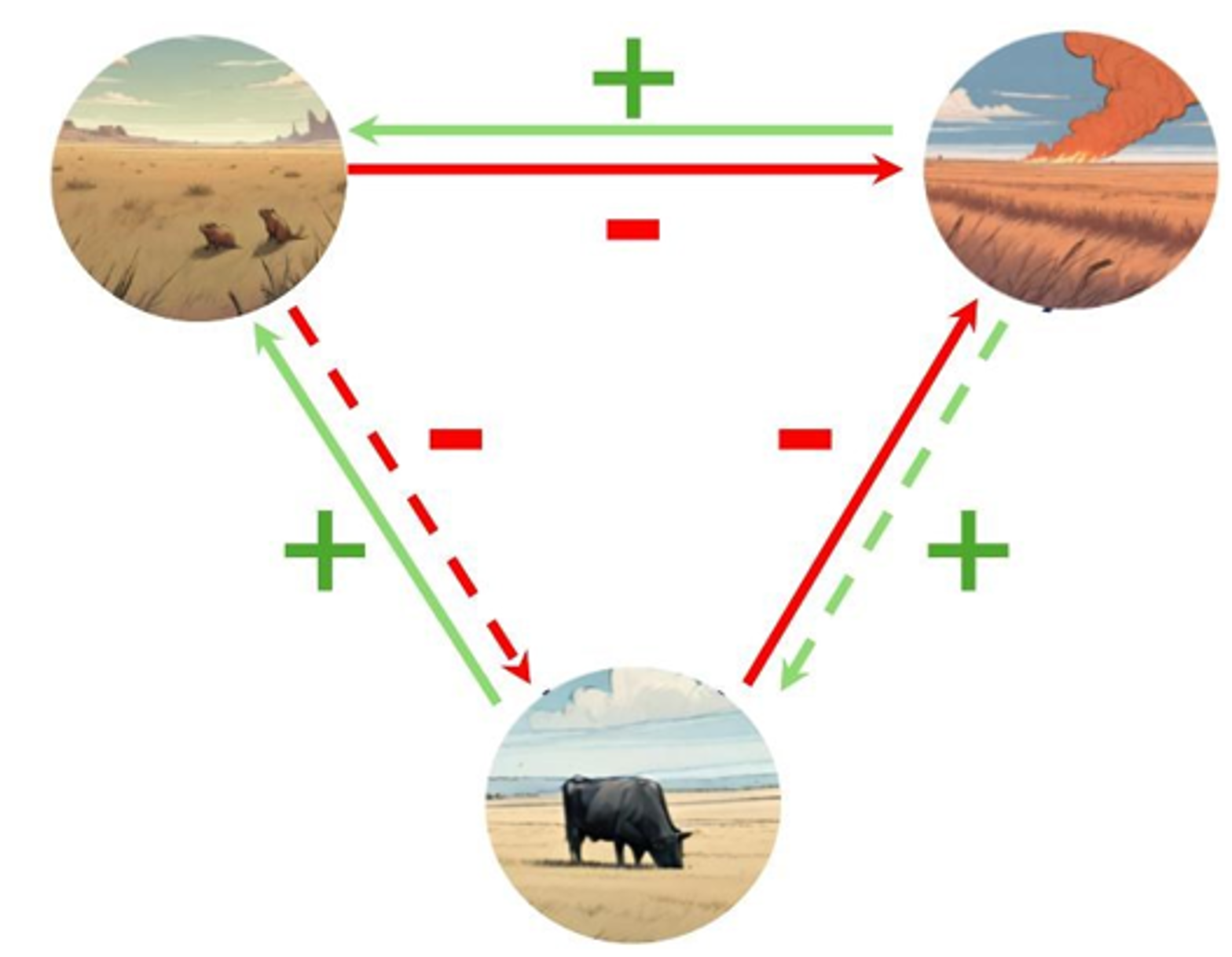
Duchardt et al. “Figure 2b” from A disturbance triangle: The interactive role of prairie dogs with fire and ungulate grazing in the Great Plains. Figure created through Canva AI.
Summary of Paper
Grassland ecosystem structure is strongly influenced by the interaction of fire and grazing, a coupled disturbance known as pyric herbivory. Fires reduce accumulated dead vegetation, opening space for regrowth and returning nutrients to the soil through ash deposition, which increases forage quality in recently burned patches. This attracts large herbivores (e.g., cattle, elk, bison), while allowing fuel to accumulate in less heavily grazed areas.
However, a less-studied component of pyric herbivory is the influence of small burrowing animals, such as prairie dogs. Prairie dogs are ecosystem engineers and keystone species that modify vegetation structure and soil across grasslands. Prairie dogs aerate soil, reduce the encroachment of woody plants, provide habitat for other wildlife, and are important prey for numerous predator species.
Duchardt et al. (2025) propose a disturbance triangle between fire, large herbivore grazing (e.g. cattle, elk, bison), and prairie dogs (Figure 2b, above). The authors conducted a literature review examining the lesser studied interaction of fire and prairie dogs, and found very limited empirical research directly examining this relationship.
Fire creates suitable habitat for prairie dogs to expand their colonies. After establishment, prairie dogs reduce vegetation biomass and fuel continuity, potentially reducing the severity and intensity of future fires. However, they also improve forage quality by keeping plants at an early growth stage where their nutrient content is highest. Thirdly, large herbivore grazing facilitates prairie dog expansion and suppresses fires by reducing vegetation biomass.
This paper highlights the possibility of incorporating prairie dogs into rangeland management, and calls for additional research directly examining interactions among fire, grazing, and prairie dogs.
Take-Home Points
- Grasslands are structured by pyric herbivory, a coupled disturbance of fire and grazing herbivores.
- Prairie dogs are an overlooked component of pyric herbivory, and are widespread keystone species and ecosystem engineers in grasslands.
- Prairie dogs likely reduce fire spread and intensity by lowering fuel load and continuity, although empirical evidence of this is limited.
- The authors highlight examples of reduced wildfire spread in prairie dog colonies including the Gilbert Ranch Fire (MT), Wildcat Creek Fire (WY), Beaver River Fire (OK), and the Marshall Fire (CO).
Management Implications
- Prairie dogs are a potentially useful management tool for reducing fire spread.
- Prairie dog colonies could be useful in fire mitigation by acting as fuel breaks, but more empirical studies are needed.
- The relationship between prairie dogs and livestock is not inherently detrimental and instead is context-dependent (e.g., land area, drought, herd size).
- Prairie dogs can improve the quality of livestock forage even if they reduce the quantity of total forage.
- Fire and mowing can be used to facilitate prairie dog reintroduction to an area.
Contributors

Lauren Haas
Author