How Transformation of the Sagebrush Biome via Annual Grass Invasion is Altering Songbird Communities
Project Start and Stage
Status: Complete
Brief Project Description
Many land managers and ecologists are watching terrestrial ecosystems rapidly transform under novel stressors like climate change, altered disturbance regimes, and biological invasions. Across woodlands, grasslands, and aridlands, transformations pose serious threats to biodiversity and human wellbeing. Although we know that higher trophic levels are affected by habitat change, most contemporary work on climate-mediated ecological transformation focuses on shifts in dominant vegetation, with animal communities receiving comparatively little attention for their roles in and responses to transformation.
Former NC RISCC graduate student Brendan Hobart, along with other members of the NC RISCC team, recently completed a project investigating the effects of annual grass invasions on songbird communities. The accompanying article was published in Frontiers in Ecology and the Environment.
The project focused on invasions across the sagebrush biome and analyzed multiple decades of monitoring data on 40 different songbird species. As annual grass transforms the sagebrush biome, songbird communities are also shifting: sagebrush and riparian specialists are declining, while grassland bird species are beginning to increase.
Our work suggests that this shift in bird communities is in its early stages and that the reorganization of bird communities will continue over the coming decades. The paper illustrates the consequences of habitat transformation on wildlife communities and presents maps showing where songbird diversity may be expected to shift.
Project Goals
The goal of this project was to quantify the effects of annual grass invasions on songbird communities, including identifying which species and avian guilds were most sensitive to sagebrush biome transformation.
Image and Figures
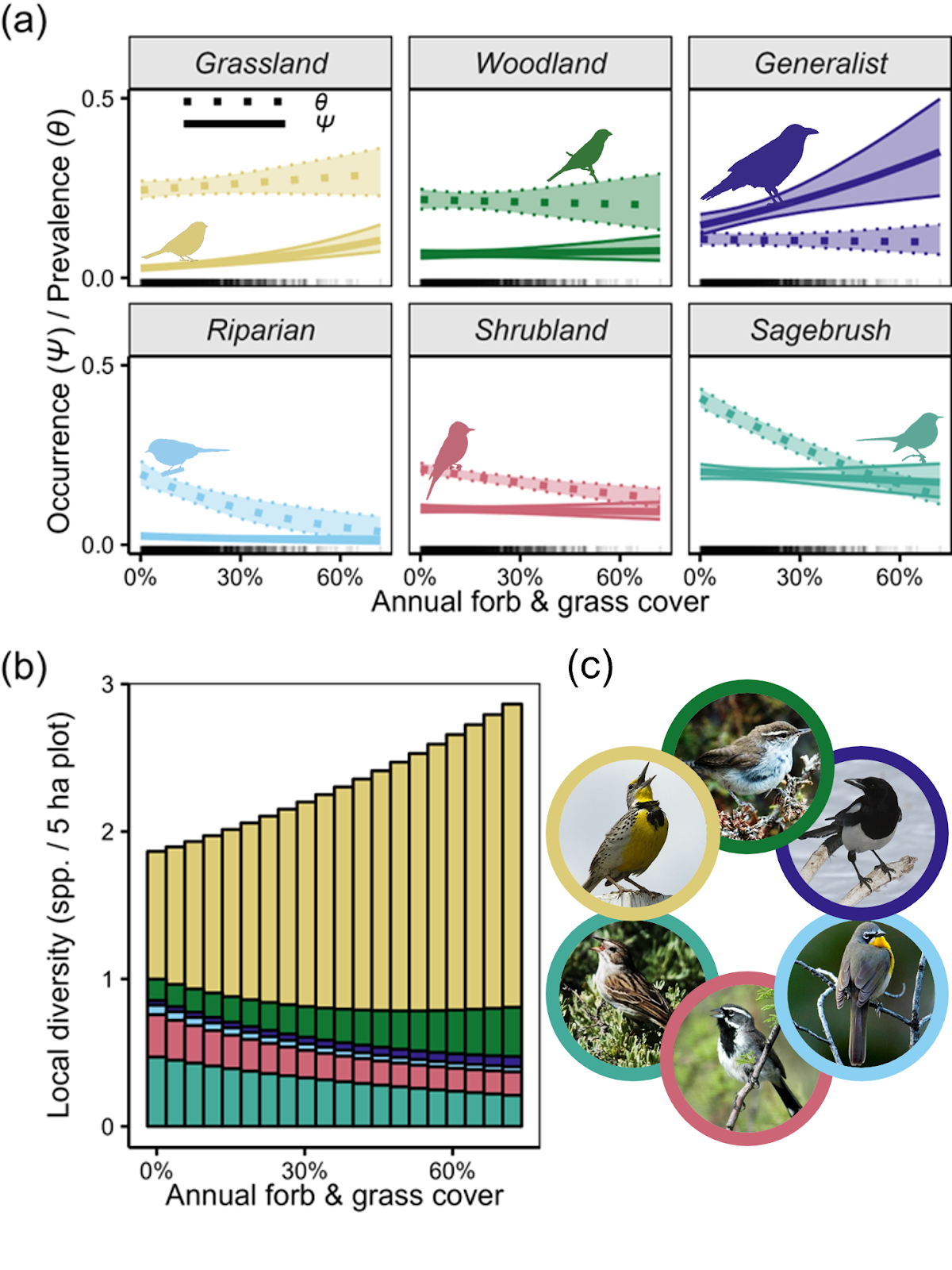
Figure 1. (a) Effects of annual grasses on songbird prevalence (ϴ) and occurrence (ψ) varied among the six avian guilds. Error ribbons depict 90% credible intervals incorporating uncertainty in intercepts and slopes. Rugs (ticks along the x axis) depict site-level annual grass values. All other covariates were held at their means. (b) Annual grasses drove shifts in community composition; predicted community dissimilarity rose by ~50% across this invasion gradient (Appendix S1: Figure S2). (c) Guild representatives, starting at the top and moving clockwise: Bewick’s wren (woodland; Thryomanes bewickii), black-billed magpie (generalist; Pica hudsonia), yellow-breasted chat (riparian; Icteria virens), black-throated sparrow (shrubland; Amphispiza bilineata), Brewer’s sparrow (sagebrush; Spizella breweri), and western meadowlark (grassland; Sturnella neglecta). Image credits: (a) Phylopic (all six icons: CC0 1.0 Universal) and (c) Bill Schmoker (all six photos).
Relevant Links
Read the journal article Read The Wildlife Society highlight
Team Members

Brendan Hobart

Wynne Moss

Chelsea Nagy