RISCC Spotlight
Nate Goeckner
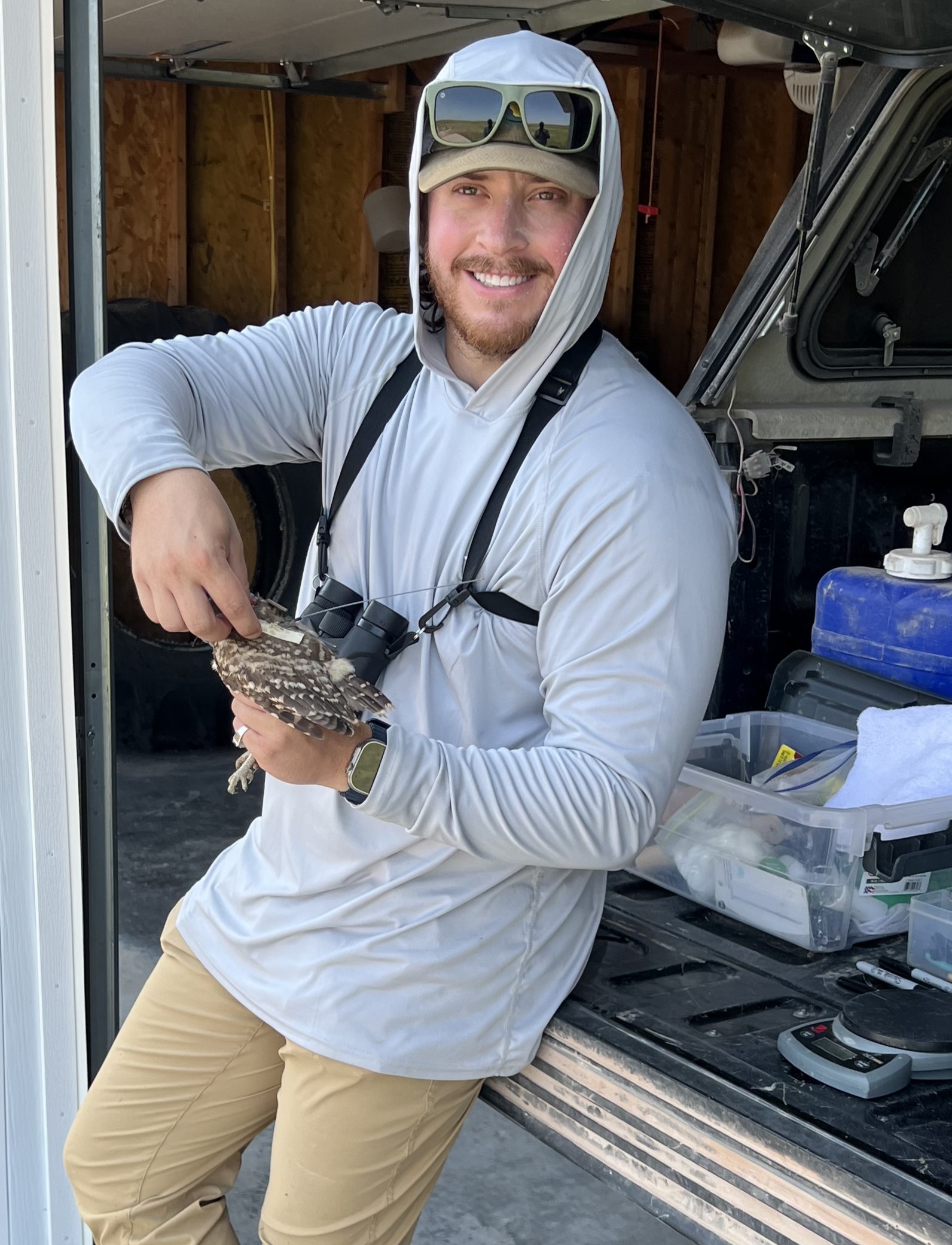
The State of Land Management in Colorado’s Front Range
the role of collaboration and adaptability
Today, Colorado’s grasslands scarcely resemble the diverse ecology of pre-colonization. In the past, this ecosystem would have grown as a complicated mosaic of different species, each puzzled together. Today, much of the prairies lie devoid of variance, with monoculture acres blanketing the land.
This homogeneous ecosystem is the product of anthropogenic land uses coupled with the spread of prolific noxious weeds that outcompete native species. In the Northern Front Range, land managers have been pushing back against this onslaught and prioritizing native species. This title refers to the people or entities tasked with stewarding the land. Nate Goeckner, a Colorado land manager, emphasizes the responsibility these individuals feel to rewild the land.
Goeckner started his career as a wildland firefighter with the Bureau of Land Management. After working with prescribed fire to restore ecosystems, he got “hooked” on ecology. This kickstarted a career focused on ecological restoration. He has worked for several different municipalities focusing on grasslands. Goeckner cautions that serving as a land manager is not a straightforward career; you have to enter this profession with curiosity and a willingness to learn.
Sometimes, Goeckner explains, you have to become an expert on something you have “absolutely no idea about”. Once, he even had to become a specialist in cold- and warm-water fish species, despite never having studied fisheries in his career. This adaptability echoes the need for varied land restoration methods.
Adaptive Management in Colorado
The restoration of Colorado’s grasslands is a convoluted task. Goeckner admits that you would struggle to find an ecosystem that hasn’t seen an introduced plant, and the sustainable solution isn’t linear. Instead of prescribing a specific solution, he suggests trying everything.
This multifaceted approach could include anything from biocontrol (like Dalmatian Toadflax weevils from a lab in Palisade), to mechanical removal (like using grazing goats to target weed species), to chemical methods (like using herbicides on cheatgrass). With mitigation methods spanning from weevils to weedkillers, collaboration is a critical facet of management. Land managers can see what strategies are working and what are not worth their time.
The Role of Collaboration
To expand research capacity, land managers have started going straight to the source, the scientists themselves. In the Greater Boulder and Denver Metro area, land managers have received support from the various universities, particularly the University of Colorado Boulder.
A main challenge for land managers, Goeckner explains, is finding information that directly applies to the land you are managing. For example, an applicable research article may have been published somewhere relatively close to Colorado, like Eastern Oregon, but missing critical local ecological context.
Within the surplus of available research, it can be difficult to find information that directly applies to the land you are managing. Instead, land managers are saddled with compiling data and determining its relevance to the specific plant communities on the property.
This is where organizations like the North Central Regional Invasive Species and Climate Change Network (NC RISCC) are relevant. RISCC is a spanning web of inter-regional US and Canada-based networks looking to create relationships between scientists and practitioners. NC RISCC, based out of the University of Colorado, prioritizes synthesizing research for the North Central United States and engaging land managers directly.
Goeckner witnessed this collaboration firsthand at a workshop hosted by NC RISCC, where land managers reviewed a draft toolkit being created by the organization. This toolkit was created to break down different land management strategies, and the purpose of this workshop was to receive feedback on its usability.
Partnership efforts like this, coupled with a flood of passionate young people entering the industry, give Goeckner hope about the future of the land. He explains how easy it is to go bogged down by the scale of the problem. Plant ecology cannot change overnight, and Goeckner reminds us that after five years, even if you only have ten percent more native plants, that is ten percent more than you started with. And that is a win.
A Reason for Hope
At the end of the interview, I asked Goeckner what advice he would give to land managers. Having to contend with the plague of noxious species and the looming threat of climate change can be disheartening. What parting words can he give as a land manager who has seemingly tried every mitigation tool in the book? To my surprise, Goeckner advises a change of mindset and prescribes patience.
Contributors

Alexandra Welch
Writer
Nate Goeckner
Interviewee