RISCC Spotlight
Chelsea Nagy

The career trajectory of the environmentalist has a standard beginning. It starts with a love for animals, or a childhood of memories spent in the outdoors longing to be turned into an occupation. Chelsea Nagy's inspiration was a bit more convoluted. While she admits her path was partially inspired by an affection towards the natural world, she has always been driven by the bigger picture. Chelsea Nagy, the Deputy Director of the Environmental Data Science Innovation and Impact Lab (ESIIL) at the University of Colorado Boulder, has always held the fundamental desire to mitigate the big changes that are happening on our planet. Even as a child when kids were worried about penguins and pandas, Nagy was plagued by the issue of widespread deforestation. Nagy has a bright demeanor, seemingly unaffected by the gloom that haunts many climate scientists. Her passion melds with practicalism, as she substantiates plans and actualizes ideas.
Nagy got her Master's at Auburn University, a public college in Alabama nicknamed the “loveliest village on the plains”. Here Nagy kickstarted her climate career by studying how land use changes affect ecosystem services and functions. Land Use, as defined by the EPA, refers to how humans have changed the land to serve our own needs, such as for crops or housing, and how these changes affect different environmental elements like fresh water availability or soil quality. She then pursued her PHD at Brown University, where she delved into the intricacies of Amazon forest composition changes due to agriculture. The childhood thread of global issues had woven itself into her research and defined her career path. As Nagy advanced through the scholarly world, she started to question the purpose behind her research.
Early in her career Nagy lightheartedly explains that she felt her research was ending in publication. The tasking process of data collection has been completed, the results painstakingly detailed in a scientific paper, and the manuscript has undergone ruthless peer review. The paper then sits in the journal untouched except for the dedicated scholars who elect to dredge the research from obscurity. In a humorous tone, with an undercurrent of sincerity, Nagy remarks
With this in mind, Nagy shifted her focus towards science that has direct implications for ecosystems, and this pursuit led her to Bethany Bradley. Bradley is a biogeography and spatial ecology scientist based out of the University of Massachusetts Amherst, and one of the founders of the Northeast Regional Invasive Species and Climate Change (RISCC) network. RISCC is a spanning web of inter-regional US and Canada-based networks looking to create relationships between scientists and practitioners. Nagy was awed by these connections, and subsequently inspired by the deliberate partnership efforts.
Bradley and the RISCC network were synthesizing relevant research and working with practitioners to implement it, and Nagy wanted in.
Her tone still laced with excitement, even numerous years after the fact, Nagy recalls thinking “we should definitely have one of these out here”, and she did exactly that.
After getting connected to different members of the Northeast RISCC through Bradley, Nagy decided to found the North Central RISCC to bring this model of stakeholder engagement to a new region.
The North Central encompasses Colorado, Wyoming, Kansas, Nebraska, South Dakota, North Dakota, and Montana. The North Central region has its own flavor of invasive species challenges, and Nagy has high ambitions of making changes, no matter how incremental.
These little things take the form of shifts in land management, one area at a time.
During this interview, Nagy explained how, particularly in the western U.S., land managers can be individual owners, but also organizations like The Nature Conservancy, the Bureau of Land Management, Colorado Parks and Wildlife, and more.
Deploying synthesized science to change how land is managed in the North Central Region is a (moderately) straightforward idea on paper, but in reality, it all comes down to collaboration.
Nagy explains with a cheeky smile. Instead, she outlines, they need to know the best available science to inform their decisions.
The merging of these two different entities, the land managers and the scientists, has been Nagy’s lofty goal during her time as director.
To bridge this historical animosity, Nagy had to initiate this connection like any other relationship, through open communication.
Nagy recalls a conference hosted by NC RISCC right after the COVID-19 era, which served as the first real attempt to bring these different communities together.
She details how the parties each took turns explaining their perspective and addressing the room on equal footing.
After the conference, she was left with the overwhelming feedback that people enjoyed hearing from the land managers, especially what their biggest challenges were.
These were scientists and people from the community who got to hear, perhaps for the first time, the anecdotal effects of the phenomena they are studying.
At a more recent conference in 2024, Nagy started to turn this collaborative concept into a reality. This was a smaller nuanced conference focused specifically on ecological transformations.
Nagy tells me with a beaming smile, as if “really cool” can sum up the fruition of a lifelong ambition.
While people are sure to be charmed by Nagy’s enthusiasm when talking about NC RISCC, the average person may be confused as to why this organization has chosen to focus on two of the largest environmental problems, instead of picking one of the already daunting topics.
In reality, climate change and invasive species are so intertwined with each other that it would negate the solution to leave one out of the equation.
Nagy admits that she can become “pigeon-holed” into the climatic-invasive relationship present in the Western grass fire cycle, but she also walks me through the broad scope of the connection.
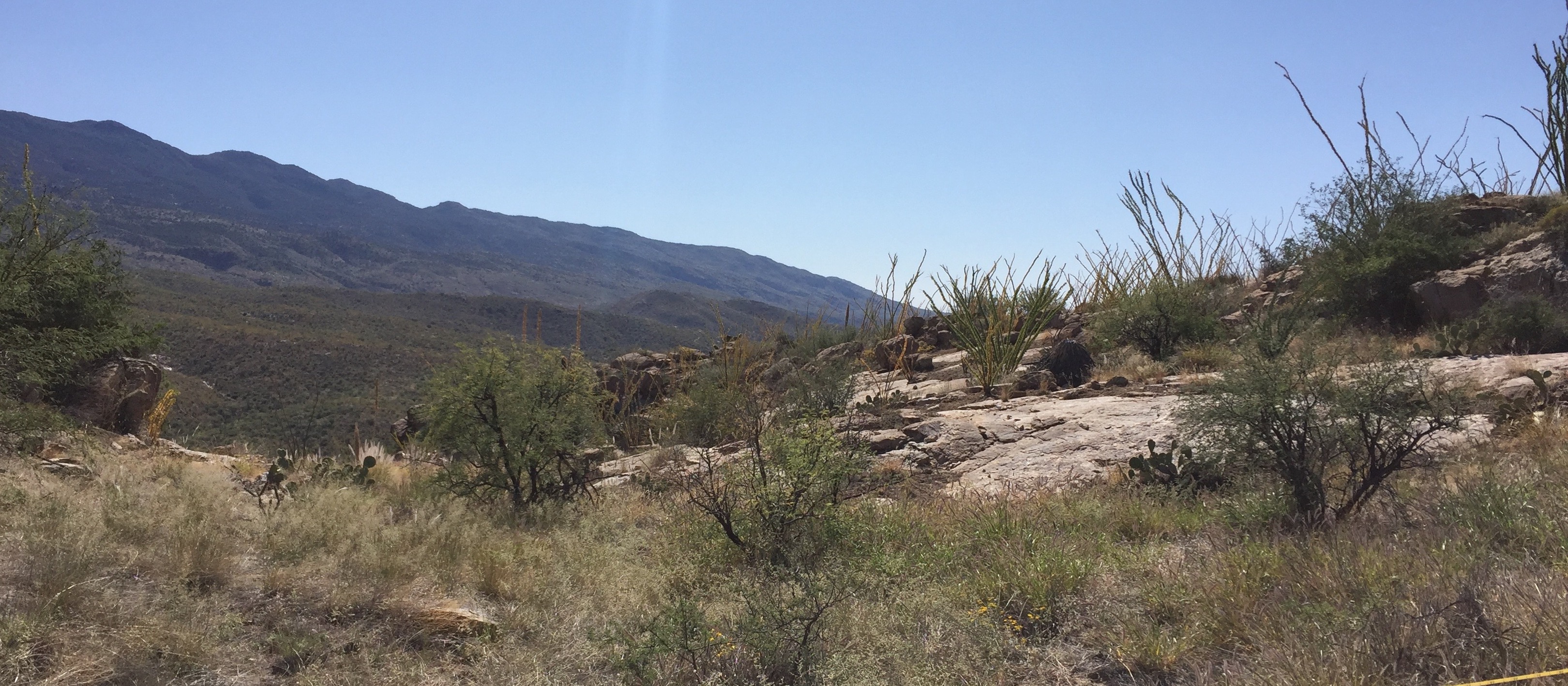
Invasive Buffelgrass: Image from field work Nagy conducted on Buffelgrass (Cenchrus ciliaris) invasion near Tucson, Arizona. Buffelgrass is a non-native perennial bunch grass that can increase the frequency and intensity of wildfire where it invades. Photo credit: Dylan Murphy.
With the effects of climate change, invasive species are starting to shift their ranges, and therefore are being introduced into new areas deemed previously inhospitable to these species.
Compounding this issue, extreme climate events (think drought, flooding, wildfires) are becoming more frequent, leaving prime new real estate for encroaching invasive species in the aftermath of this destruction.
People are also shifting their recreation habits in response to climate change, and potentially tracking invasives back from their new winter boating location.
Even the timing of the seasons themselves is being influenced by climate change, with certain invasives adapting quickly to emerge earlier and outcompeting native species.
Nagy stresses that these problems are all knotted together, but she has shown me that the solution might lie in a tangled symbiosis as well.
Nagy stresses, and she is hopeful NC RISCC will sustain to make those solutions happen.
Contributors

Alexandra Welch
Writer
Chelsea Nagy
Interviewee